Wandering Through Time: Incheon’s Hidden Architectural Gems
Ever walked through a city and felt like you were stepping between eras? That’s Incheon for you. I didn’t expect much beyond its modern airport, but wandering its streets revealed stunning layers—colonial facades, traditional hanok villages, and bold contemporary designs all sharing the same skyline. Each corner tells a story of resilience, trade, and cultural fusion. From the quiet dignity of 19th-century Western consulates to the serene symmetry of wooden Korean homes and the gleaming precision of futuristic Songdo, Incheon is a city built on contrasts. This is urban exploration at its most rewarding, where every building is a chapter in Korea’s evolving narrative.
First Impressions: Beyond the Airport Hub
Incheon is often seen as a gateway rather than a destination. Millions pass through its sleek international airport each year, heading to Seoul or beyond, rarely pausing to consider what lies just a short subway ride away. Yet, for those willing to linger, the city unfolds as a layered tapestry of architectural history. The modern efficiency of the airport—its sweeping glass halls and digital wayfinding—stands in quiet contrast to the low-rise neighborhoods that still bear the marks of a much older Korea. This duality is not a contradiction but a defining feature of Incheon’s identity.
Unlike many cities that have erased their past in the name of progress, Incheon has preserved its historical fabric with quiet determination. The city was one of Korea’s first ports opened to foreign trade in 1883, and that legacy is still visible in its streetscapes. While high-rises and shopping centers mark its economic ascent, tucked between them are remnants of a cosmopolitan past—brick buildings with gabled roofs, narrow alleys lined with wooden shopfronts, and unexpected courtyards that seem untouched by time. These spaces invite travelers to slow down and look closer, to move beyond the role of observer and become explorers of a living urban story.
What makes Incheon especially compelling is how naturally these layers coexist. There is no forced separation between old and new. A 19th-century consulate may stand across the street from a glass-fronted café, and a traditional hanok courtyard might be nestled behind a modern department store. This seamless blend reflects the city’s resilience and adaptability. For the thoughtful traveler, Incheon offers not just sights, but a deeper understanding of how cities evolve—not by replacing the past, but by building upon it.
Jeongdongjin Village: Where History Meets the Sea
One of the most evocative chapters in Incheon’s architectural story unfolds in Jeongdongjin, a quiet district that was once the heart of the city’s foreign settlement. When Incheon Port opened to international trade in 1883, diplomats, merchants, and missionaries from Europe and North America established homes and institutions here. The buildings they left behind—modest in scale but rich in character—still stand as testaments to Korea’s early encounters with the wider world.
The architecture of Jeongdongjin is marked by Western design elements adapted to the Korean climate and context. Red brick walls, steeply pitched roofs, and arched windows are common features. These buildings were constructed with durability in mind, using imported materials and craftsmanship that reflected both the status of their occupants and the technological exchange of the era. The former Russian Consulate, for example, is a low-slung structure with symmetrical proportions and a sense of restrained elegance. Though no longer used for diplomatic purposes, it remains a protected cultural site, its presence a quiet reminder of Incheon’s role in Korea’s opening to foreign powers.
Nearby, the Catholic Church of Jeongdong—officially known as Incheon Jeongdong Church—rises with a simple steeple against the skyline. Built in the early 20th century, it combines Gothic Revival elements with local construction techniques. Its stained-glass windows filter light into soft hues, creating a contemplative atmosphere inside. The church has survived wars, urban development, and decades of change, serving as both a place of worship and a historical landmark. Together with the surrounding buildings, it forms a rare ensemble of late 19th and early 20th-century foreign architecture in Korea—a quiet district where history feels tangible.
Walking through Jeongdongjin today, one is struck by the stillness. The area is not crowded with tourists or commercial activity. Instead, it offers a sense of intimacy and authenticity. Benches under old trees invite pause, and interpretive signs provide context without overwhelming the experience. For visitors interested in architecture and history, this neighborhood is a quiet revelation—a place where the past is not reconstructed or dramatized, but simply present.
The Charm of Hanok in Gaehang-ro
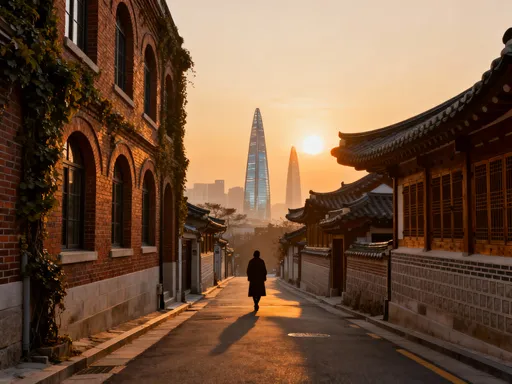
If Jeongdongjin speaks to Incheon’s international past, Gaehang-ro tells the story of its local soul. This historic street, located near the old port, was once a bustling commercial corridor where Korean merchants, Chinese traders, and foreign buyers exchanged goods. Today, it is one of the best places in the city to experience traditional Korean architecture, particularly the hanok—wooden homes with tiled roofs and curved eaves that have defined Korean domestic design for centuries.
But Gaehang-ro’s hanok are not replicas of those found in Seoul’s Bukchon or Jeonju. They reflect a unique adaptation to Incheon’s identity as a port city. Many of these buildings were not just homes but also shops and warehouses, designed for both living and commerce. As a result, they often feature wider frontages, larger doors for moving goods, and upper floors used for storage or guest accommodations. The wooden beams are thick and darkened by time, supporting roofs made of heavy gray tiles that curve gently at the corners. Narrow alleys branch off the main street, creating a maze-like atmosphere that encourages exploration.
What sets Gaehang-ro apart is its architectural fusion. Due to the city’s historical ties with China, particularly through the nearby Incheon Chinatown, many buildings incorporate Chinese-style decorative elements—lattice windows, red lacquered doors, and rooftop ornaments that resemble those seen in southern Chinese architecture. This blend is not forced or artificial; it emerged naturally from decades of cultural exchange. The result is a streetscape that feels distinctly Incheon—neither purely Korean nor foreign, but a harmonious synthesis.
Visitors today will find that Gaehang-ro is not a museum piece but a living neighborhood. Some hanok have been converted into cafés, tea houses, and small galleries, where the scent of roasted barley tea mingles with the sound of traditional music. Others remain private homes, their owners maintaining the buildings with care. The area is especially beautiful in the early morning or late afternoon, when sunlight slants across the tiles and the shadows of wooden beams stretch long across the pavement. It is a place that rewards slow walking and quiet observation.
Modern Contrasts: Songdo’s Futuristic Skyline
Just a short drive from the historic districts of Incheon lies Songdo International Business District—a city built from scratch on reclaimed land in the Yellow Sea. Where Gaehang-ro and Jeongdongjin speak of centuries of organic growth, Songdo represents a bold vision of the future. Designed with input from international urban planners, it is one of the most ambitious smart city projects in Asia, featuring high-speed internet in every building, automated waste collection systems, and LEED-certified skyscrapers.
The architecture of Songdo is defined by glass, steel, and geometric precision. Towering office buildings with reflective facades rise above wide boulevards arranged in a grid pattern. Parks and waterways are integrated into the urban fabric, offering residents green space and recreational opportunities. At the heart of the district is Central Park—a linear waterway lined with walking paths, cycling lanes, and modern sculptures. Modeled after its namesake in New York, it serves as both a leisure destination and a symbol of Songdo’s global aspirations.
What makes Songdo particularly interesting is how it balances innovation with livability. Unlike some futuristic developments that feel sterile or impersonal, Songdo includes mixed-use buildings where people live, work, and shop in close proximity. Rooftop gardens, solar panels, and rainwater harvesting systems are standard features, reflecting a commitment to sustainability. Public transit is efficient, with subway lines connecting Songdo to Incheon and Seoul, reducing reliance on cars.
Yet, Songdo also invites reflection on the nature of urban development. While its architecture is undeniably impressive, it lacks the patina of age and the sense of accumulated stories found in older parts of Incheon. There are no weathered bricks or creaking floorboards—only clean lines and digital interfaces. For some visitors, this contrast is jarring; for others, it is inspiring. Songdo does not replace the old city but complements it, offering a different kind of architectural experience—one shaped by data, efficiency, and forward-thinking design.
Hidden Courtyards and Forgotten Temples
Between the grand narratives of colonial districts and futuristic skylines, Incheon holds quieter, more intimate spaces—small shrines, tucked-away temples, and private courtyards that have survived decades of urban change. These sites are rarely featured in travel guides, yet they offer some of the most meaningful encounters with the city’s architectural soul.
One such place is a modest Buddhist temple nestled behind a row of modern apartment buildings in the Jung-gu district. With a simple gate and a single prayer hall, it is easy to miss. Yet inside, the architecture speaks of continuity and quiet devotion. The wooden altar is carved with traditional motifs, and the roof is supported by unpainted beams that show the grain of the wood. A small garden with a stone lantern and a few potted plants adds to the sense of serenity. This temple, like others in the city, serves a small local congregation, offering a space for reflection amid the rush of daily life.
Similarly, hidden courtyards can be found in unexpected places—behind shops, between office buildings, or accessible only through narrow alleyways. Some are remnants of older hanok complexes that have been partially demolished, leaving a single inner yard intact. Others are newer constructions designed to mimic traditional layouts, with wooden pavilions and rock gardens. These spaces, though small, provide a sense of enclosure and peace, a contrast to the open, grid-like planning of modern districts.
What unites these sites is their resilience. They have not been preserved as monuments but have endured through continued use and community care. They remind visitors that architecture is not only about grand statements or iconic forms, but also about the small, everyday places where people gather, remember, and find solace. In a city that is constantly changing, these quiet enclaves offer a different kind of beauty—one rooted in simplicity and continuity.
Street-Level Architecture: Markets, Cafés, and Alleyways
To understand Incheon’s architecture fully, one must look beyond landmarks and monuments to the spaces of daily life. The city’s markets, underground malls, and café-lined alleys reveal how design responds to climate, commerce, and community needs. These are not buildings created for aesthetic impact, but for function—shaped by decades of use and adaptation.
The Bupyeong Underground Shopping Mall is a prime example. Stretching for several blocks beneath the city, it is a network of stalls selling clothing, accessories, and snacks. The architecture here is utilitarian—fluorescent lighting, tiled floors, and low ceilings—but it serves a vital social role. During hot summers and cold winters, it provides a climate-controlled space where people can shop, meet, and pass through safely. The layout encourages wandering, with branching corridors and occasional open plazas where food vendors gather.
Traditional markets like the Incheon Nambu Market offer a different kind of street-level experience. Here, corrugated metal roofs provide shade and shelter from rain, while wooden stalls display fresh produce, dried seafood, and household goods. The arrangement is organic, with narrow passageways that open into wider communal areas. These markets are not just places to buy food—they are social hubs, where vendors know their customers by name and conversations flow as freely as the scent of grilled fish.
In recent years, Incheon’s retro buildings have become homes to independent cafés and bookshops, particularly in neighborhoods like Dapyeong and Songdo’s older commercial strips. A former textile warehouse might now house a coffee roastery with exposed brick walls and industrial lighting, its design honoring the building’s past while serving a new purpose. These adaptive reuse projects show how architecture can evolve without losing its character. They also reflect a growing appreciation among locals for authenticity and craftsmanship in an age of mass production.
Why Architectural Wandering Matters
Walking through Incheon’s diverse districts is more than a sightseeing activity—it is a way of connecting with the city on a deeper level. Architecture, more than any other urban element, tells the story of who we are, where we’ve been, and what we value. In Incheon, that story is complex and layered: a port city shaped by trade, a community that honors its past while embracing innovation, and a place where quiet resilience is written into the very walls of its buildings.
When we take the time to observe architectural details—the curve of a roof, the texture of brickwork, the layout of a courtyard—we engage in a form of mindful travel. We move beyond checklists and photo ops to a more reflective experience. We begin to see cities not as static destinations, but as living, breathing entities shaped by time, culture, and human effort. This kind of awareness fosters empathy and appreciation, not just for Incheon, but for urban spaces everywhere.
In an age of rapid development and global homogenization, places like Incheon remind us of the importance of preserving diversity in the built environment. Each architectural layer—colonial, traditional, modern—adds depth and meaning. They are not competing visions, but parts of a continuous conversation across generations. By wandering through these streets with curiosity and respect, we become part of that conversation.
So the next time you pass through Incheon, consider staying a little longer. Step off the transit route and into the alleys, courtyards, and quiet corners. Let the city reveal itself not in grand gestures, but in the quiet details. In doing so, you may find that you’re not just exploring a place—you’re discovering a story that has been unfolding for over a century, one brick, beam, and blueprint at a time.